


Some numbers you have to read twice. This is one of them.
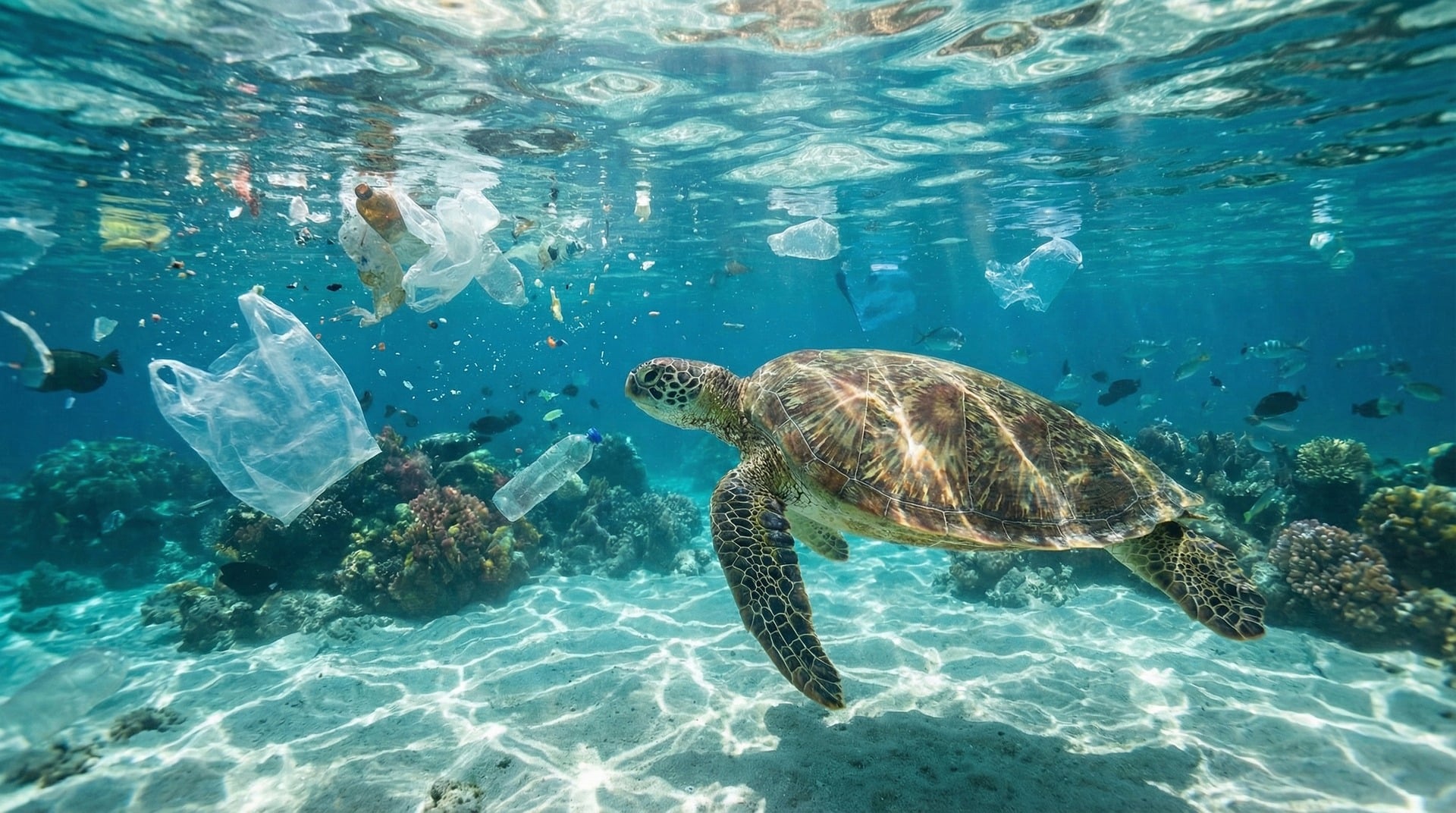
Every year, 52.1 million tonnes of plastic waste escape any management system: dumped, burned or left in the environment. Not in a century. Not in a decade. In a single year. And a very significant share ends up in the ocean. As you read this article, plastic is flowing into the ocean from rivers, beaches, landfills and sewage systems all over the planet.
The Third World Ocean Assessment, produced by some 600 scientists from 86 countries and published by the United Nations in June 2026, is the most complete picture we have of the state of our seas. And it puts numbers on something we already sensed, but need to face head-on.
Plastic doesn't disappear. It just gets smaller.
When plastic reaches the ocean, it doesn't dissolve. It breaks apart. Sun, waves and time break it into smaller and smaller pieces until it turns into microplastics: particles under five millimeters that float invisibly in the water, settle into seabed sediments and enter the food chain.
How many are there? WOA III estimates that the upper layers of the ocean hold 24.4 trillion microplastic particles. A number so large it's hard to picture. To put it in perspective: if we shared them out among everyone on Earth, each of us would get about 3,000.
And the most unsettling part isn't the quantity. It's what they do.
Plastic, especially in the form of microplastics, already affects more than 4,000 marine species. Many swallow it, mistaking it for food, and it builds up in their tissues. And through the food chain, it can reach us too.
A problem that starts on land
Here's one of the keys: much of the plastic that reaches the sea comes from land. Waste that isn't collected, that's dumped into rivers, that's carried off by the wind. According to WOA III, rivers and overflows caused by extreme rainfall are among the main pathways by which that waste reaches the sea. The ocean doesn't produce its own pollution. It receives it.
This has a direct implication: what we do on land matters at sea. The decisions we make every day (what we buy, how we throw it away, what we demand from brands and governments) have consequences that travel all the way to the bottom of the Atlantic or float in the Mediterranean.
The Mediterranean in the spotlight
And speaking of the Mediterranean: it is one of the seas hardest hit by plastic pollution. Because it is semi-enclosed, plastic builds up there with particular intensity. Plastic that gets in has no easy way out.
For those of us who live on its shores, this is no distant statistic. It's the water we swim in. It's the ecosystem that sustains the fishing, the tourism and the cultural identity of millions of people in Spain, France, Italy, Greece, Morocco and more than a dozen other countries.
So what do we do?
Faced with numbers this big, the temptation is to freeze. If there are 24 trillion microparticles floating in the ocean, what difference can a recycled can, a beach clean-up or a single individual action make?
More than you might think. Because the problem isn't only measured by what's already in the sea, but by what we stop adding. Every plastic bottle that doesn't end up in the ocean matters. Every recycling system that works matters. Every company that chooses recyclable materials, and pushes its industry to do the same, matters.
One more figure from the report: 40% of the litter found in the ocean is single-use plastic. Exactly the kind of packaging we have chosen not to make.
The WOA III scientists didn't write this report to spread despair. They wrote it because data is the foundation of action. Because naming the problem precisely is the first step towards solving it.
At Ocean52, we believe the same. That's why we share what the science says, without sugar-coating it, but without resignation either. And that's why, through No Plastic Ocean, for every aluminum bottle of water or soft drink we sell, the equivalent weight of one single-use plastic bottle is removed from the ocean: 14,692 kilos between 2023 and June 2026, verified on blockchain.
The ocean deserves our attention 52 weeks a year. And our action, too.
Main source: Third World Ocean Assessment (WOA III), United Nations, June 2026. woa.un.org